Nikon D300 DX 12.3MP Digital SLR Camera (Body Only) Right now
Saturday, October 31, 2009
by Smith
| Posted in
Best Nikon D300,
Buy Nikon D300,
Cheap Nikon D300,
Discount Nikon D300,
Looking for Nikon D300,
Nikon D300 DX 12.3MP Digital SLR Camera (Body Only)

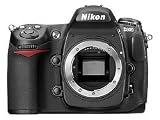
I've been holding back from buying the D300 since the launch because I own a D200, but when my wife came home and surprised me with one... not only was I surprised by her gift, but also by what Nikon has packed inside this camera. I will try not to write on what others have already said, but I'll point us to some areas which are new and may not have gotten enough attention towards.
1. AF Fine Tuning - this is a great feature that puts in the user's hands the power to calibrate a lens to the camera body. In the past, if you have a great prime lens (e.g. 85mm f/1.4) and want to calibrate it to work optimally to the camera body, you would need to send it to teh Nikon Service Center to do that. With AF Fine Tuning, you can now do it yourself. Because there will be a slight degree of inaccurarcy in AF systems, i.e. front or backward focusing, you can now fine tune that lens (with +/- 20) to the camera body so that it works optimally. It recognizes Nikon lenses without a problem but 3rd party lenses would have to catch up. It can store up to 12 lenses' fine tuning information, so that when you plug back that lens, it would know the fine tune data to use.
2. Monochrome Picture Control - The monochrone picture control now comes with filter effects or yellow, orange, red, and green... so gone are the days of carrying these filters when taking black and white shots. You can also adjust the toning from black and white, sepia, cyanotype, and also a range of red, yellow, green, blue green, blue, purple blue, and red purple.
3. Improved Picture Control for colors - the settings now are sharpening, contrast, brightness, saturation and hue. You can also download from the internet D2XMODE picture controls (there are 3 modes) and load it in to emulate these modes from the D2X bodies.
4. White balance fine tuning - The Canon 5D had long since had this feature in the white balance tuning where you can shift the white balance in a grid, and finally, this is now incorporated in this camera. Even the other white balance fine tuning is much improved, e.g. for flourascent, it hast a list of different florescent lights to choose from for fine tuning. For the present white balance, you can save up to 4 presets.
5. In camera picture editing made easier - Once you take a picture, when you press the "ok" button, a list of in camera picture editing tools come up (where you can trim the pic, change to monochrone, use filter effects of skylight or warm filter, or edit the color balance). The color balance feature here is great because you can shift the color balance of the picture to the desire effect you like.
6. Help button - at anytime when you need some help as to what that feature is about, you only need to press the "?" button and it brings up a page explaing that feature. This is like the D40/x and the menu layout also looks like that of the D40/x.
The D300 is without a doubt leaps and bounds ahead of the D200 and their competitors. The high ISO is great, and auto white balance more accurate. It is without a doubt the best semi-pro camera Nikon has produced.
-----
After 2 months of using the D300, and shooting some events, this is what I have discovered about it. I thought it was going to be easy to move from a D200 to D300, but realized there is a learning curve as well. I was frustrated at not being able to capture a shot like I did with the D200, but as I discovered along the way while using the D300, that it gives you more flexibility and adjustments, which means more control in your hands... but that also means that just out of the box may not get you what you used to have almost out of the box for the D200.
When shooting in a well-lit outdoor scenario, the D300 performs very well. Focusing is fast, sharp, and auto-ISO works well too. Most of my issue arise when shooting indoors with difficult lighting... and the following points have all to do with indoor shooting.
- When shooting an indoor concert with a fast lens and no flash and using auto-ISO with different metering modes, the camera tends to over expose the shots, and some were very over exposed. The overexposure come from the inability of the D300 to decide what ISO to use, and in some scenarios, it went to ISO 1600 when ISO 200 or 400 in that lighting condition would do. Advise is to forget about auto-ISO with indoor shooting.
- When shooting indoors without flash, the camera tends to overexpose the shot by 1/3 to 2/3 with matrix metering. This is easily resolved by adjusting the exposure compensation. Another way is to use center-weighted average, which is more consistent in the metering.
- The default sharpening for the D300 is less than the D200. Hence, the pictures may look a little soft, so would need to bump up the sharpening by maybe +3 in your picture control. This is more for shooting in jpegs, but some people prefer to leave the sharpening to post processing.
- With a 12MP camera, my shooting flaws + lens sharpness is more evident. This is where breathing techniques, how to hold the camera, etc. becomes more evident with the pictures taken. Also, I have found the AF fine tuning useful to adjust the front or back focusing of the lenses... and even Nikon lenses needs some adjustments.
- The LCD is too bright and does not reflect the true exposure of the picture. The picture may look alright on the LCD but when downloaded onto a computer, it looked underexposed. You would need to decrease the LCD brightness by -1 or -2.
Get more detail about Nikon D300 DX 12.3MP Digital SLR Camera (Body Only).